
By Ishmam Ashan, Dodge Economist
Post-secondary education construction will struggle to gain momentum in 2027 as disruptions in federal research and development (R&D) funding, coupled with rising construction costs and demographic shifts, weigh on activity. Construction starts remain subdued across research-intensive R1 universities, while overall post-secondary construction is also weakening after a strong 2025.
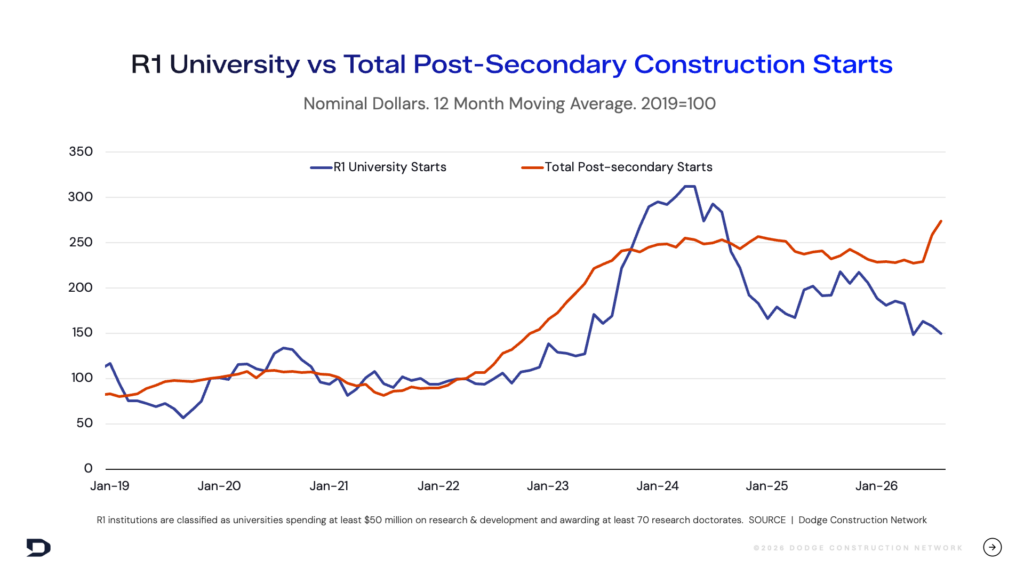
R1 universities have historically accounted for the largest share of federal research dollars, but the funding environment turned volatile last year after the federal government announced caps on indirect cost reimbursement for National Institutes of Health (NIH) and National Science Foundation (NSF) grants. While Congress ultimately rejected the proposed funding reductions, the pace of new NIH and NSF grants to universities has slowed to a trickle, declining over 50% relative to historical standards. During the same period, the One Big Beautiful Bill (OBBBA) raised the excise rate on endowment investment income at the Ivy Leagues to as high as 8%, up from a flat 1.4% and potentially costing the Ivies hundreds of millions of dollars more each year.
Research-intensive R1 universities spend over $50 million a year on R&D and capital spending extends beyond lecture halls and laboratories. Many R1 universities own and operate advanced research facilities and healthcare centers, which are now being directly impacted by NIH and NSF funding disruptions. In addition, these facilities tend to be in expensive metros with high cost per square footage, which further constrains budgets and drags down real activity.
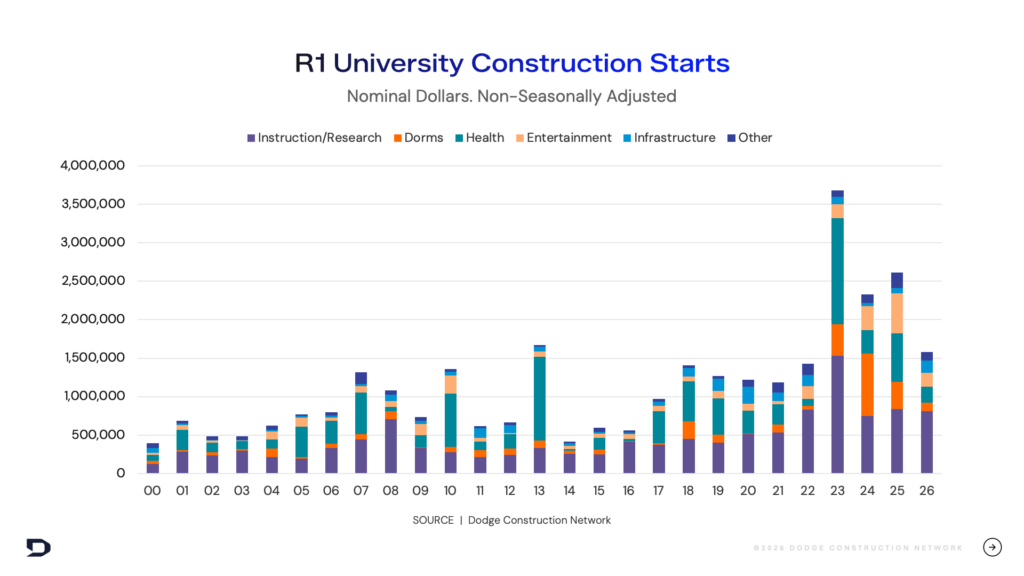
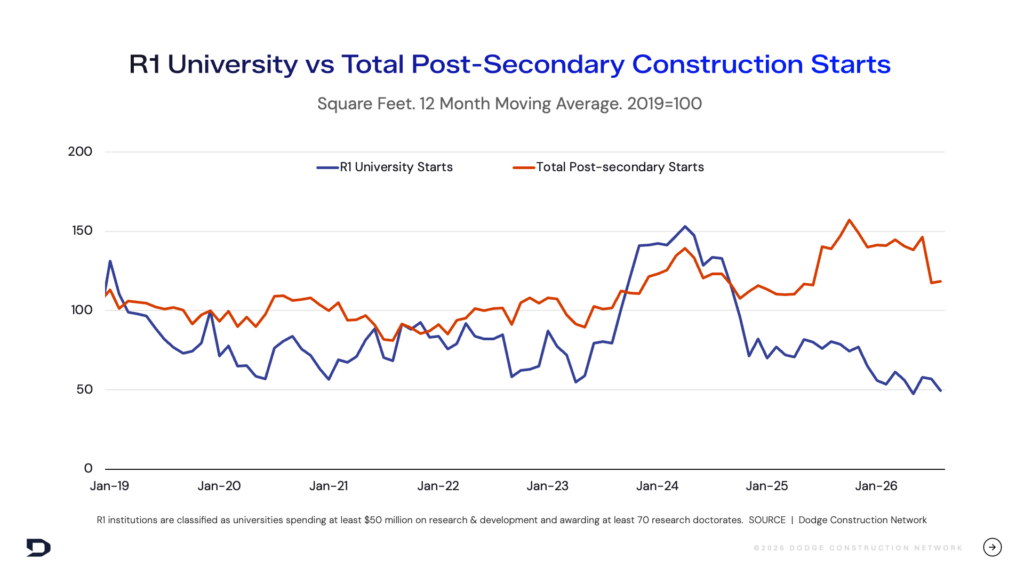
After moderating last year, square footage across the R1 universities declined 29% year-to-date through August 2026. Healthcare starts also declined for the same period and consisted largely of renovations instead of new construction that historically led activity. Total post-secondary education square footage weakened 23%, reversing a strong 2025. Projects are also taking longer to get going, with the lag from planning-to-start stretched to 16 months, up from 12 months in 2024.
We believe funding disruptions and higher endowment taxes will keep post-secondary construction subdued, and that weakness will spill over into total education starts. For our forecast, that means total education starts rising just 2% in 2027 to 115 million square feet, down from the 6% gain we expected in 2024, before the disruptions began. Starts should then grow at a moderate pace over the longer term.