Broad Strength in Nonresidential Planning, Data Centers Pause
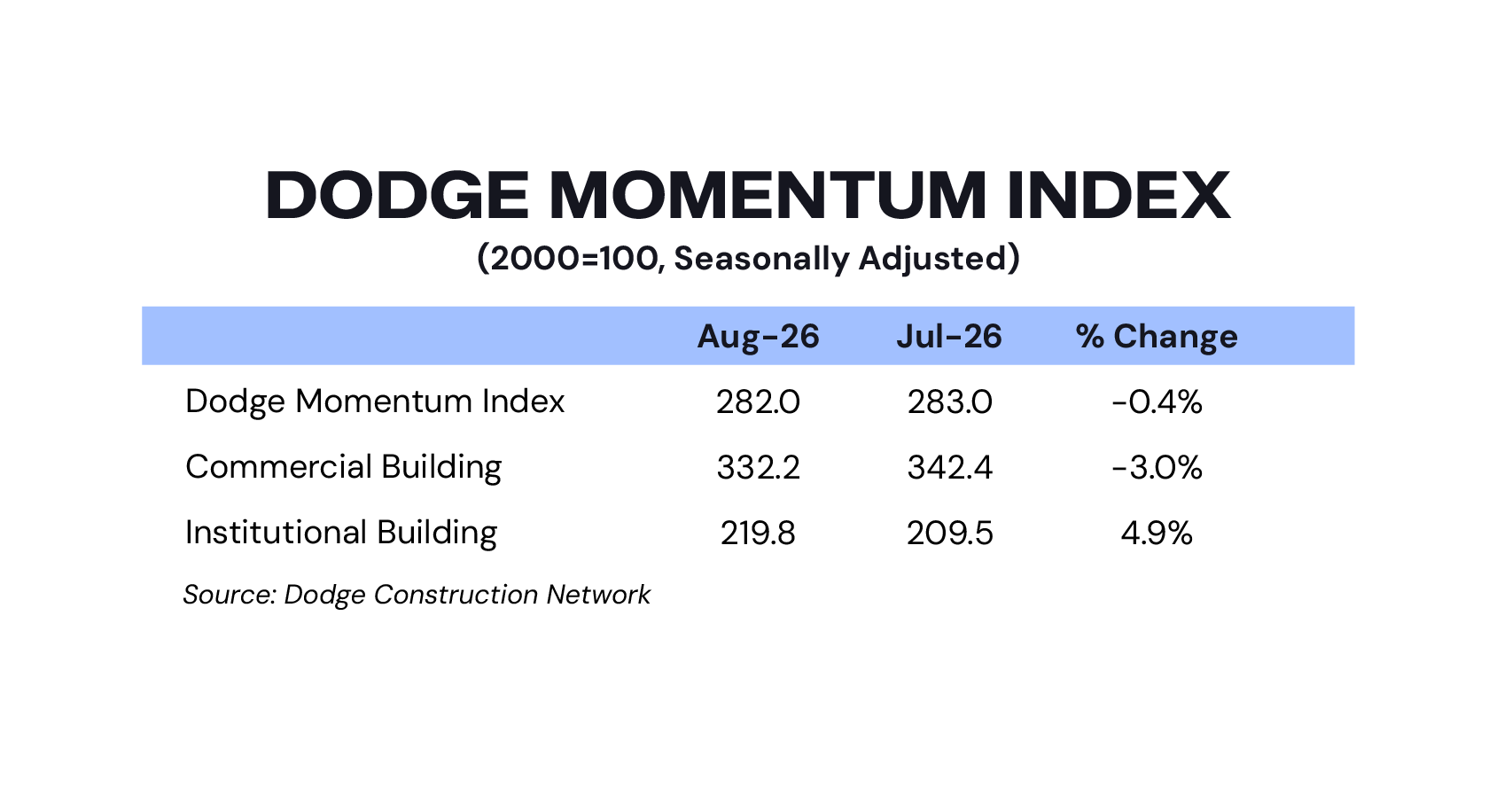
BOSTON, MA – September 8, 2026 — The Dodge Momentum Index (DMI), issued by Dodge Construction Network, ticked down 0.4% in August to 282.0 (2000=100) from the downwardly revised July reading of 283.0. Over the month, commercial planning declined 3.0% and institutional planning grew 4.9%.
“Strength in planning momentum remained relatively broad-based in August,” said Sarah Martin, Director of Economic Research at Dodge Construction Network. “Weaker data center planning predominantly drove the flatter trend, while most other sectors saw an acceleration in planning momentum.”
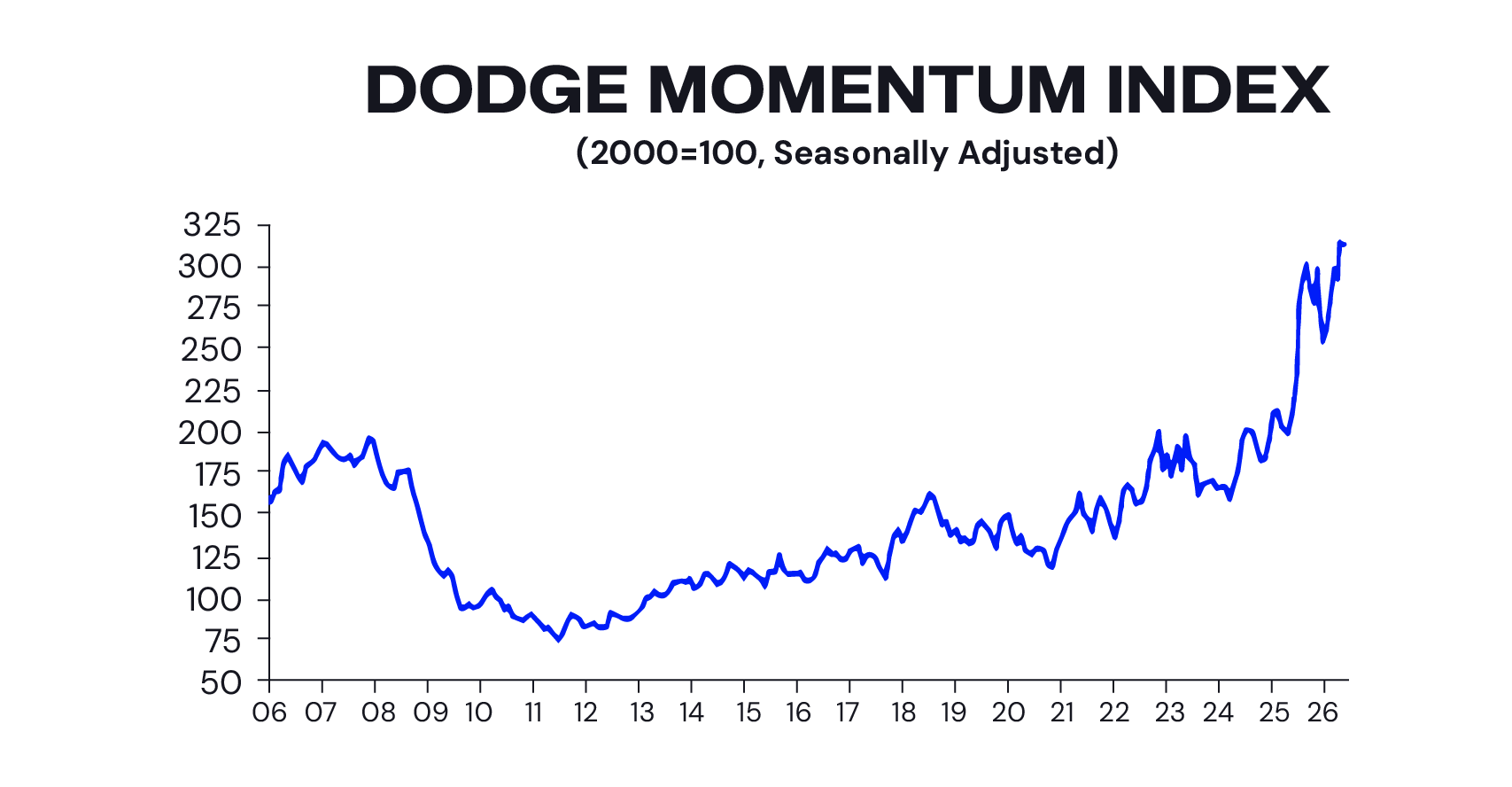
Commercial planning activity slowed down for data centers, retail stores and warehouses throughout August, while office buildings, parking garages and hotels picked up steam. On the institutional side, education, recreational, and public buildings saw a stronger planning pipeline, while healthcare activity slightly pulled back after four months of sustained planning growth. Year-over-year, the DMI was up 4.2% when compared to August 2025. The commercial portion of the index was up 2.3% and the institutional portion was up 7.8% over the same period. When removing data centers, the commercial segment would be down 18.9% from year-ago levels, given the surge in activity seen in late 2025.
A total of 31 projects valued at $100 million or more entered planning throughout August. The largest commercial projects included two EdgeConneX Data Centers (Buildings 31 and 32) in Bastrop, Texas, each valued at $462 million, the $378 million Bitdeer Data Center (Phase 1, 150 MW) in Shalersville Township, Ohio, and a $358 million Data Center in Secaucus, New Jersey. The largest institutional projects to enter planning included the $350 million Colosseum Sports Resort in Stafford, Virginia, the $350 million Commonwealth Courts Building in Richmond, Virginia, and the $350 million Holistic Health and Fitness building in Newport News, Virginia.
The DMI is a monthly measure based on the three-month moving value of nonresidential building projects going into planning, shown to lead construction spending for nonresidential buildings by a full year to 18 months.