
Written by: Eric Gaus, Chief Economist at Dodge Construction Network
The Bottom Line
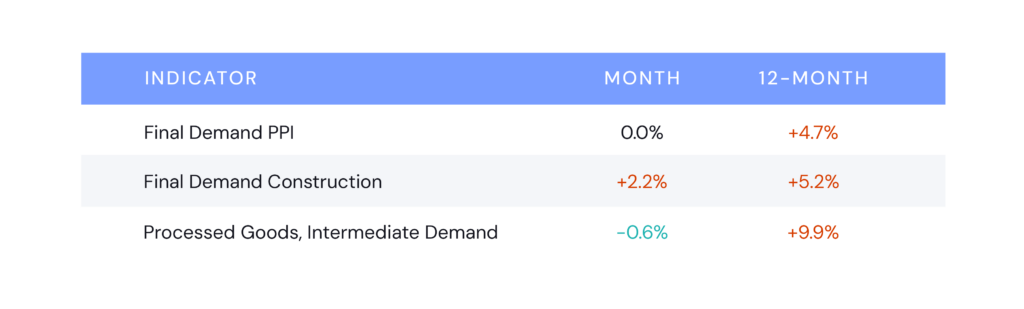
The Producer Price Index for final demand was unchanged in July, held flat as a 3.1 percent drop in energy prices offset gains elsewhere. Construction costs were one of the areas providing lift to the overall index. Final demand construction prices jumped 2.2 percent, the sharpest single-month move since 2022, after four months of near-zero change. Construction prices are up 5.2 percent over the past year, outpacing the 4.7 percent gain in the broader index. A calm headline number sits atop a construction market that repriced quickly.
Key Indicators
What the Data Shows
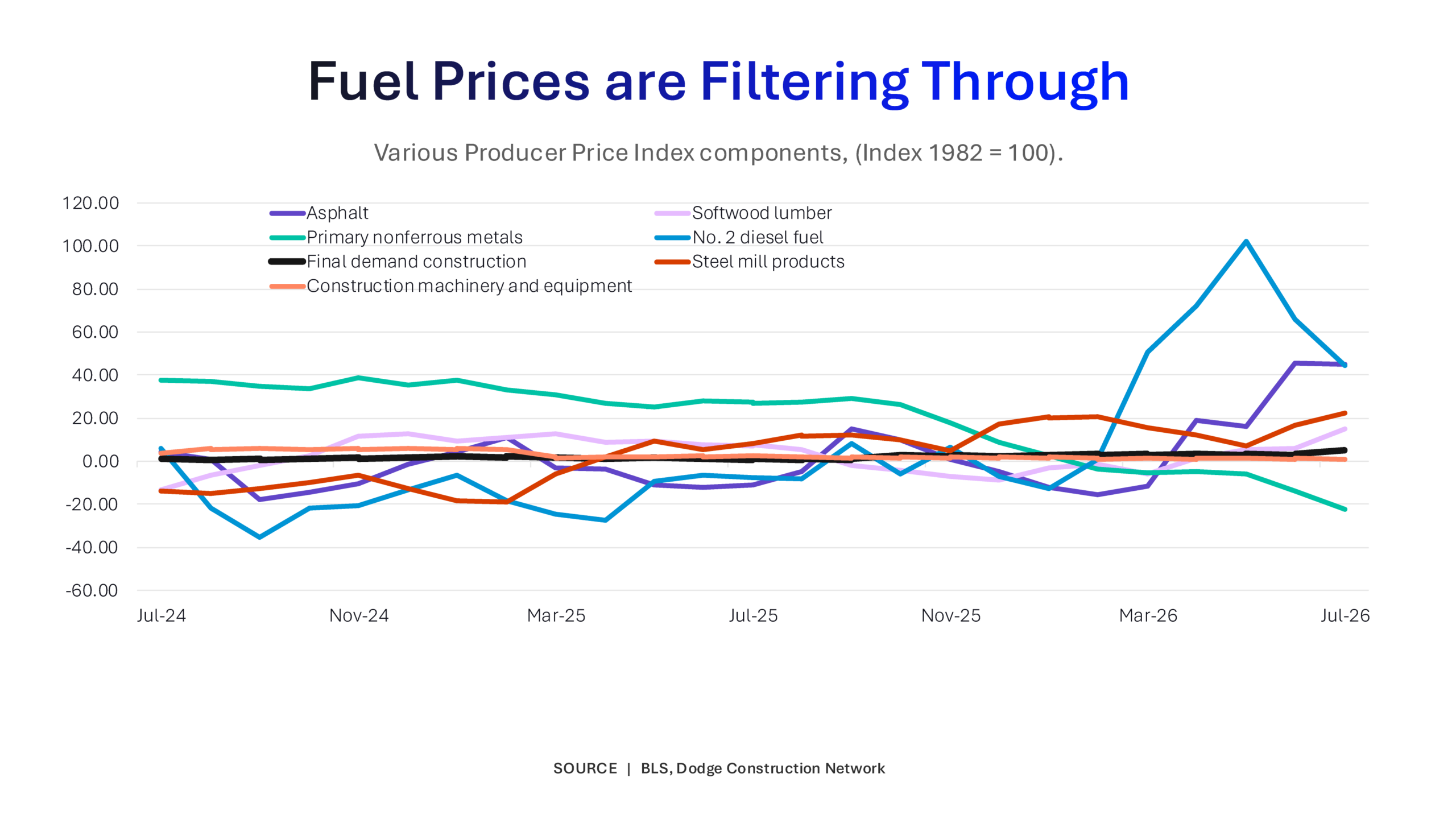
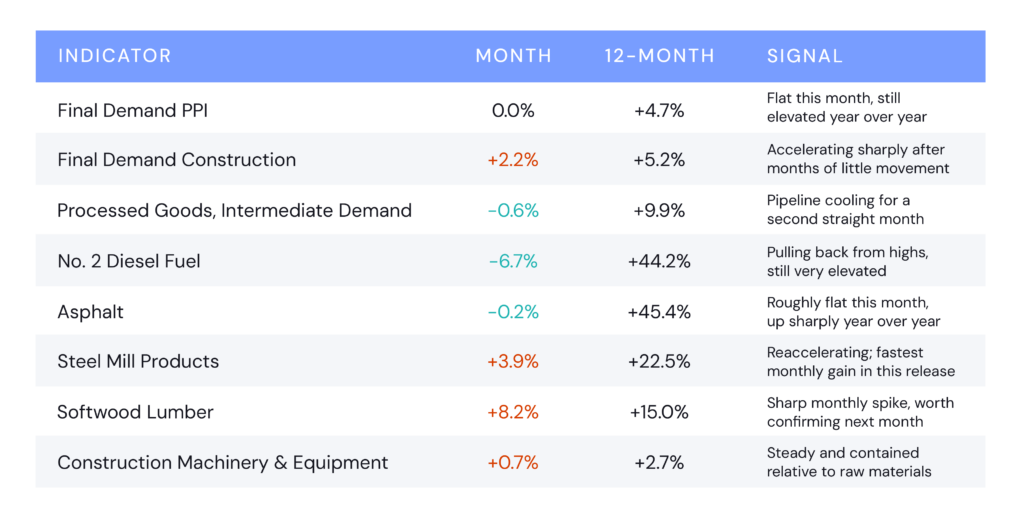
Energy retreated in July, but not from a low base. No. 2 diesel fuel, which powers most heavy equipment and hauling, fell 6.7 percent on the month yet remains up 44.2 percent for the year. Gasoline fell 5.7 percent and is up 37.1 percent year over year. Trucking eased too, down 1.8 percent for the month but still up 10.9 percent year over year. The monthly declines look like relief, but they follow months of sharp increases. Energy prices are a core input for all construction, which will likely continue to see aggressive repricing in the coming months.
Metals sent a mixed signal. Steel mill products rose 3.9 percent for the month, and are up 22.5 percent year over year. As a major input to data center construction demand is contributing at least as much as the increased energy costs. Primary nonferrous metals fell 7.6 percent in July, aluminum mill shapes fell 1.6 percent, and copper and brass mill shapes fell 2.9 percent, all pulling back after sharp earlier increases. Even so, primary nonferrous metals remain up 52.8 percent over the past year and aluminum mill shapes are up 40.5 percent.
Softwood lumber jumped 8.2 percent in July and is up 15.0 percent over the past year, a sharper move than either energy or metals and one that matters for anyone estimating wood-framed construction. Construction machinery and equipment stayed calm by comparison, rising 0.7 percent in July and just 2.7 percent over the past year, a gap typical of this stage in a cost cycle. We expect machinery and equipment to increase more throughout the year as the input prices filter through the supply chain.
Trend Context
The intermediate demand pipeline, prices manufacturers and builders pay for goods before they reach final demand, is a useful leading indicator for where construction costs may head next. Processed goods for intermediate demand fell 0.6 percent in July after falling 1.1 percent in June, the second straight decline following a surge that ran from February through May, when the index rose between 1.5 and 3.0 percent a month. Unprocessed goods for intermediate demand followed a similar arc, falling 1.8 percent in July after a 6.4 percent drop in June, itself a reversal from a run of gains earlier in the spring.
That cooling pipeline makes July’s construction jump notable. One plausible explanation is that the February-through-May surge in intermediate materials costs due to increased fuel costs is now working its way into contracted construction prices with a lag, even as the raw input pipeline has started to cool. If so, some of July’s increase may reflect catching up rather than a new acceleration. The continued tension over the Strait of Hormuz suggests that while we might not see further acceleration of inflation, we are unlikely to see much deceleration either.
What It Means for Construction
For estimators and contractors preparing bids this fall, the safest assumption is that materials pricing has not settled into a predictable pattern. Steel is reaccelerating while other metals pull back, energy is easing month to month but remains elevated year over year, and lumber just posted another monthly increase after 2 months of stability following the 12% jump in April. Contracts that lock in a single price for materials several months out carry real risk. Escalation clauses tied to a defined index, rather than a fixed allowance, are worth discussing with owners on projects bidding through the fourth quarter.
Owners and developers should treat the 5.2 percent 12-month increase in construction prices as the more relevant budgeting number than the flat headline PPI, since it reflects what construction specifically has cost. Projects with paving, steel, or wood-framing scopes carry the most exposure right now, given the size of the moves in asphalt, steel mill products, and softwood lumber this month. Building contingency for those specific trades, rather than applying a flat percentage across the whole budget, should better match where the risk sits.
The intermediate demand pipeline, the leading indicator for input costs, has cooled for two straight months in line with oil prices falling back below $100 per barrel. Input costs and what construction actually charges do not always move together, and July is a clear example of that gap opening. Whether construction prices keep rising even as the pipeline cools, or July proves a one-month catch-up, should become clearer once the August data arrives.
Key Numbers to Watch
Data source: U.S. Bureau of Labor Statistics, Producer Price Index, July 2026 (USDL 26-1380), released August 13, 2026.
Monthly percent changes reflect seasonally adjusted data where BLS publishes a seasonal factor. Final demand construction and most individual commodity series, including diesel fuel, asphalt, steel mill products, nonferrous metals, softwood lumber, and construction machinery and equipment, are not seasonally adjusted, consistent with BLS practice for these series. All figures are preliminary and subject to revision for up to four months after original publication. This report is prepared for internal planning purposes and does not constitute financial or investment advice.
Related Articles:
Producer Prices Surge in April. Construction Feels The Heat.
Dodge Momentum Index Grows 6% in May
January Update on Census Housing Starts and Construction Put-in-Place Spending