
Written by: Eric Gaus, Chief Economist at Dodge Construction Network
The Bottom Line
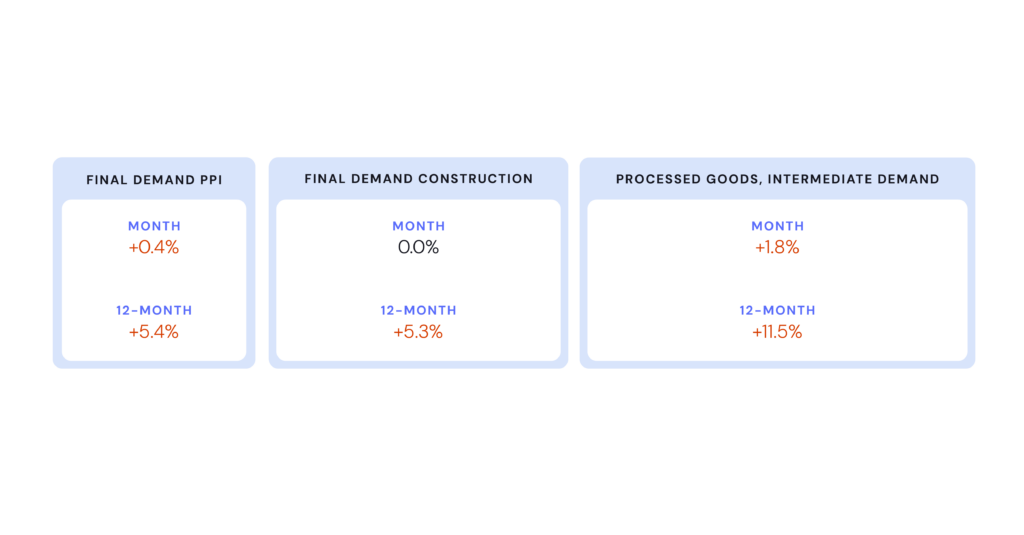
The Producer Price Index for final demand rose 0.4 percent in August, seasonally adjusted, and stands 5.4 percent above its level a year ago. Energy did nearly all of the work: final demand energy prices rose 4.2 percent, and No. 2 diesel fuel alone jumped 24.1 percent. Despite the jump in diesel, construction went sideways. Final demand construction was unchanged in August after July’s 2.2 percent jump, leaving it up 5.3 percent over the past year. Cost pressure has moved back into the input pipeline, which means we can expect further construction cost increases in coming months.
Key Indicators
What the Data Shows
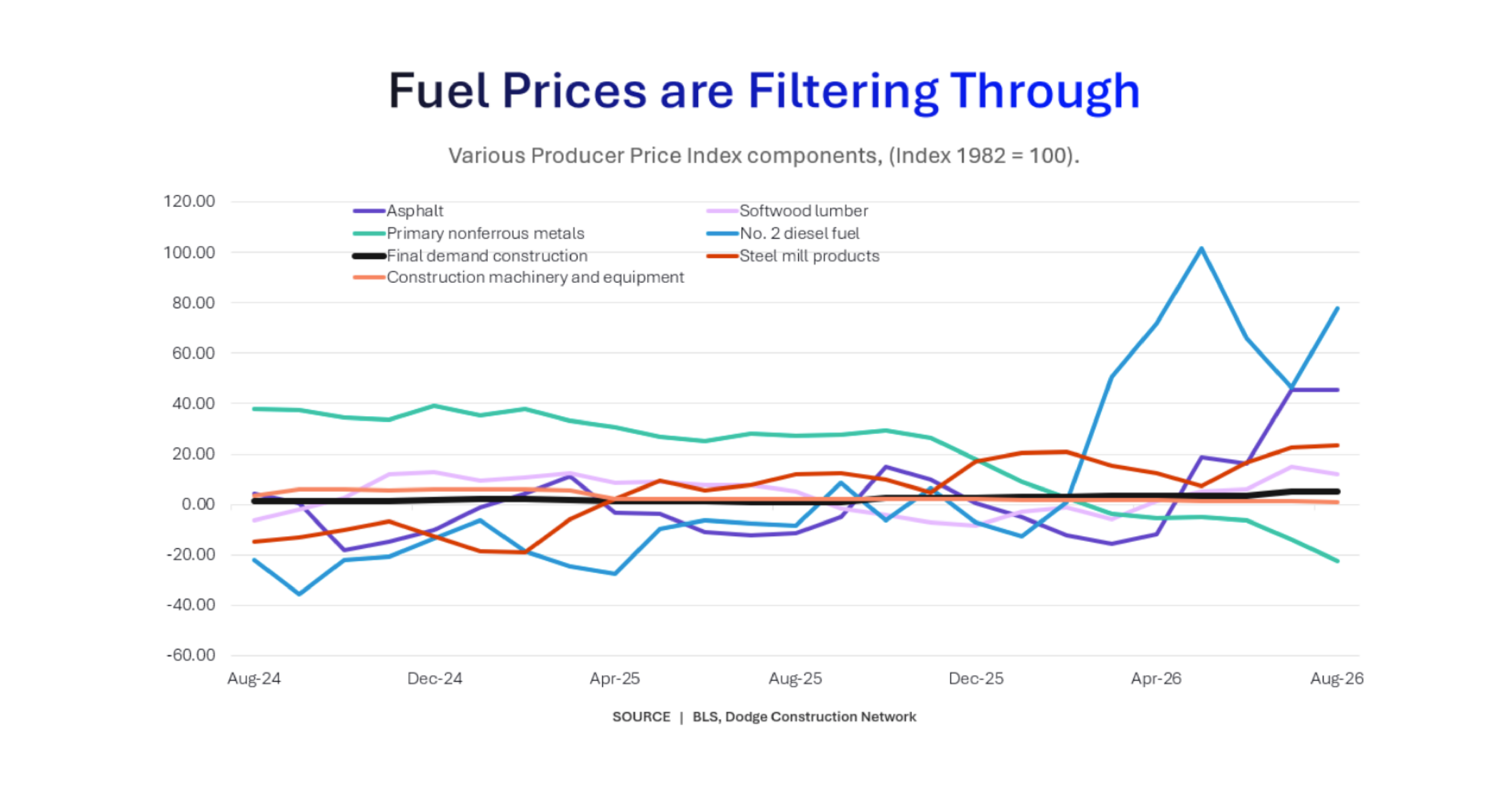
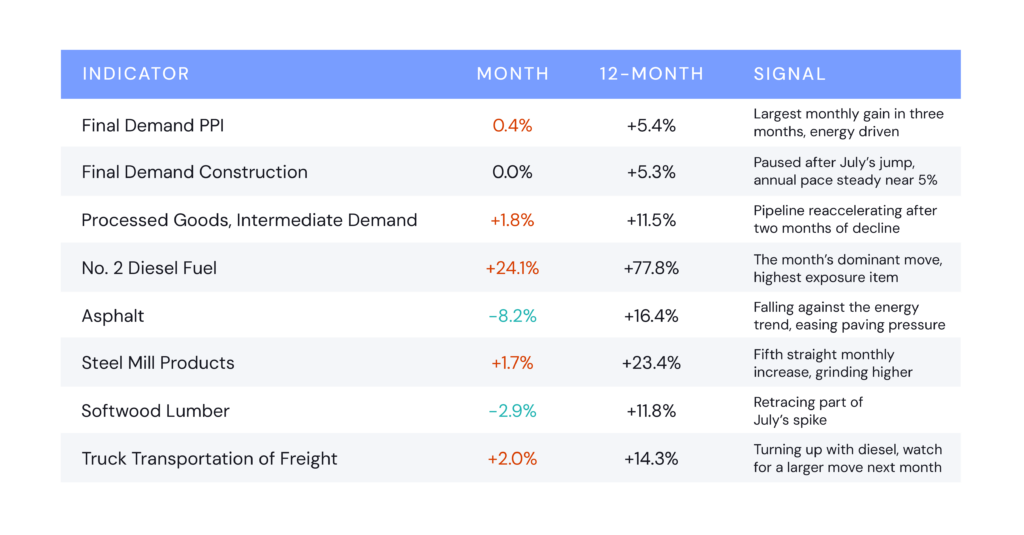
The re-escalation of the Iran war defines this release. No. 2 diesel fuel, the input that prices earthmoving, hauling, and generator hours, rose 24.1 percent in August and is now up 77.8 percent over the 12 months ended in August. BLS attributes more than a third of the month’s increase in final demand goods to diesel alone. Gasoline rose 4.2 percent and is up 46.5 percent year over year. Asphalt moved the other way, falling 8.2 percent while remaining 16.4 percent above a year ago. Truck freight rose 2.0 percent and is up 14.3 percent year over year, and freight typically tracks diesel with a short lag.
Metals were mixed and, next to energy, calm. Steel mill products rose 1.7 percent, a fifth consecutive monthly gain, and are up 23.4 percent over the past year. Copper and brass mill shapes rose 3.5 percent after two softer months and are up 20.9 percent. Aluminum mill shapes fell 4.4 percent, the largest monthly decline among these metals, and are up 27.3 percent. Primary nonferrous metals edged up 0.6 percent after July’s 7.9 percent drop and remain up 49.3 percent.
Softwood lumber gave back part of July’s spike, falling 2.9 percent and settling 11.8 percent above its year-ago level. We expect the current escalating trade war to impact lumber prices going forward. Construction machinery and equipment was unchanged for the month and is up just 2.2 percent for the year, by far the mildest series here. The gap between double-digit raw material inflation and roughly two percent equipment inflation has persisted for several months. That is consistent with manufacturers absorbing input costs rather than passing them through, but the release does not report margins, so the explanation cannot be confirmed from this data.
Trend Context
The intermediate demand pipeline, which measures what producers pay for goods before they reach final demand, reversed in August after two months of cooling. Processed goods for intermediate demand rose 1.8 percent following a 0.4 percent decline in July, with more than 80 percent of the advance coming from processed energy goods, which rose 7.3 percent. Unprocessed goods for intermediate demand rose 1.1 percent after a 0.7 percent gain in July. Over the past 12 months processed goods are up 11.5 percent and unprocessed goods are up 12.8 percent, both running at roughly twice the pace of final demand construction.
That reversal complicates last month’s reading. In June and July the pipeline cooled while construction prices jumped, and one plausible interpretation then was lagged pass-through of the spring surge. August inverts the pattern: inputs surged and construction prices stopped. Two months of opposing moves is not a trend, and this release does not explain the timing, so the more defensible view treats both as noise around a construction price series growing at roughly 5 percent a year. Clearly faster than consumer prices, and likely heading higher.
What It Means for Construction
For estimators bidding work this fall, diesel is the line item that changed. A 24.1 percent monthly increase is large enough to move the cost of any earthwork, paving, or haul-intensive scope, and fuel is usually the input least protected by a fixed-price bid. Fuel escalation clauses, or at minimum a diesel allowance priced off a recent index reading rather than a spring average, are worth raising on projects carrying heavy equipment hours. Asphalt falling 8.2 percent in the same month is a reminder that the paving cost stack does not move as a single thing.
Owners and developers should keep using the 5.3 percent 12-month change in final demand construction as the budgeting anchor rather than the flat monthly reading. Within that figure the building types diverge: new office building construction is up 6.0 percent over the past year and new industrial building construction 5.8 percent, while new warehouse building construction is up 4.3 percent. Setting contingency by building type will match actual exposure better than one blended percentage.
The divergence worth flagging is the mirror image of last month’s. Input costs accelerated sharply while the price of construction did not move at all. If the diesel increase holds through September, some of it would be expected to reach construction prices with a lag, though the size and timing of that pass-through is an inference and not something this release establishes. If diesel reverses instead, as it did in June and July, August may prove to have been a one-month energy event. Whether energy holds is the most useful thing to watch in the September release.
Key Numbers to Watch
Data source: U.S. Bureau of Labor Statistics, Producer Price Index, July 2026 (USDL 26-1380), released August 13, 2026.
Monthly percent changes reflect seasonally adjusted data where BLS publishes a seasonal factor. Final demand construction and most individual commodity series, including diesel fuel, asphalt, steel mill products, nonferrous metals, softwood lumber, and construction machinery and equipment, are not seasonally adjusted, consistent with BLS practice for these series. All figures are preliminary and subject to revision for up to four months after original publication. This report is prepared for internal planning purposes and does not constitute financial or investment advice.
Related Articles:
Producer Prices Surge in April. Construction Feels The Heat.
Dodge Momentum Index Grows 6% in May
January Update on Census Housing Starts and Construction Put-in-Place Spending