
Dodge economists are forecasting $515 billion in General Building construction activity for 2027. That’s a useful number for sizing the market — though the only part that matters to you is the share tied to your product category. And it’s the wrong number entirely for deciding which individual projects your sales team should be chasing.
That’s because total project value and addressable project value are not the same thing. A $40 million apartment building and a $40 million distribution center can represent wildly different opportunities for a flooring manufacturer, an HVAC supplier, or a lighting fixture brand — even though both projects show up identically on a market report. The total tells you the project is big. It doesn’t tell you how much of that project is actually yours to win.
Segment valuation answers that question in two distinct ways, each drawing on a different data set. The first is market sizing: applied to construction starts and forecast data, it restates a $515 billion total in terms of addressable category value — so an HVAC manufacturer sees the HVAC market size rather than the all-in figure. The second is lead scoring: applied to individual project and pipeline data, it ranks leads by the value of the scope that’s actually theirs rather than by total construction cost. The two work as one workflow, but the inputs stay distinct: starts and forecast data size the market, project data scores the leads. In this guide, we’ll walk through why total project value misleads building product manufacturers, how to size and score opportunity by product category instead, and what that looks like on an actual project.
Why Total Project Value Misleads Manufacturers
Total project value is an aggregate. It rolls up structural steel, HVAC, glazing, flooring, electrical, roofing, and dozens of other material categories into a single figure. That’s exactly what makes it useful for understanding macro trends — and exactly what makes it unreliable for scoring and prioritizing individual project leads.
When sales and market intelligence teams size opportunity using total project value, three things tend to happen:
- Large, low-fit projects get overweighted. A massive project with a small share of relevant material spend can look more attractive than a smaller project where your category represents most of the budget.
- Territory and account planning gets distorted. Regions or verticals with a high concentration of large projects can appear stronger than they actually are for your specific product line.
- Forecasting loses precision. Production planning and inventory decisions built on total construction spend, rather than category-specific demand, tend to over- or under-shoot actual need.
None of this is a data quality problem. It’s a resolution problem. Total value answers “how big is this project?” It doesn’t answer the question manufacturers actually need answered: “how much of this project is my opportunity?”
Product-specific — or segment — valuation solves this by taking a project’s total value and distributing it across material categories, based on project type and state. Instead of one number per project, you get a number per category: what the flooring scope is worth, what the electrical scope is worth, what the roofing scope is worth, and so on. That reframes the question from “which projects are the biggest?” to “which projects are the biggest for me?”
How to Size and Prioritize Opportunity by Product Category
Whether or not you’re using a dedicated tool for this yet, the underlying discipline is the same. Here’s how to do it.
Start With Category Demand, Not Project Totals
For any market or account list, identify what share of total construction value falls into your specific material category. This becomes your true addressable market — not the headline project value.
Segment by Geography, Market, and Project Type
Addressable demand isn’t evenly distributed. Break it down by state, by market sector (commercial, institutional, residential, industrial), and by project type (multifamily, warehouse, data center, and so on) to see where demand is actually concentrated.
Rank Opportunities by Category-Specific Dollar Value
Sort your pipeline by what a project is worth to your product line, not by total project cost. A mid-size project with strong category value should outrank a larger project where your category is a rounding error.
Feed Category-Level Demand Into Planning
Once you can see demand by segment, use it to inform production targets, inventory planning, and growth forecasts — rather than working backward from total construction spend.
The output of this exercise isn’t a bigger pipeline. It’s a more accurate and actionable one — sized around the deals worth your team’s time.
What This Looks Like on an Actual Project
Take a single $40 million apartment project of four or more stories. Its total value tells you it’s a large, active job — full stop. Break that same project down by material category, and a very different picture appears: plumbing represents roughly $1.1 million of the scope, HVAC around $970,000, paint $510,000, flooring $470,000, insulation $470,000, elevators $410,000, and lighting $310,000.
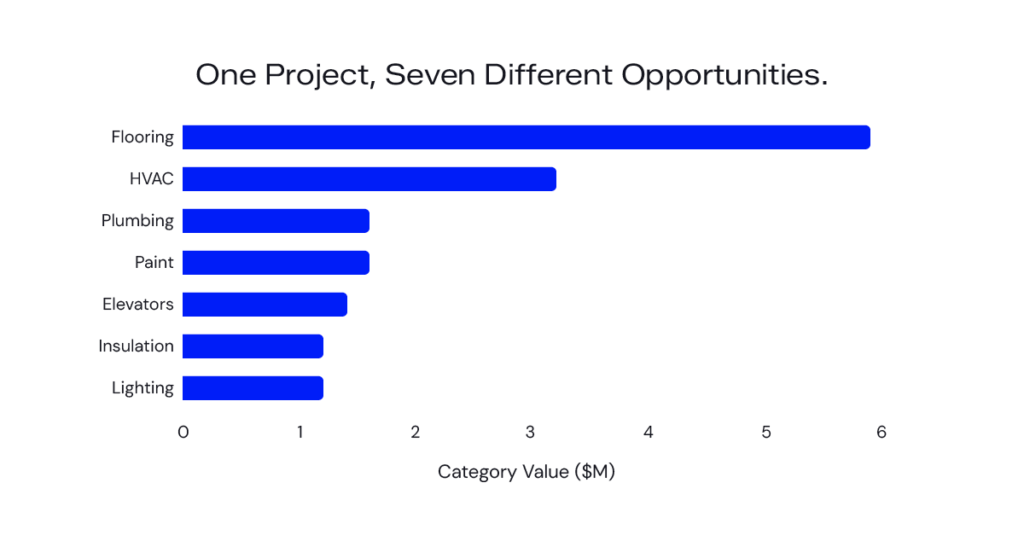
To a plumbing or HVAC manufacturer, that project is a top-tier opportunity. To a lighting manufacturer, it’s a moderate one worth pursuing but not restructuring a territory plan around. Total project value can’t make that distinction — it just tells you the job is big. Category-specific valuation tells each manufacturer, individually, what the job is actually worth to them.
That’s the shift: two manufacturers can look at the identical project and walk away with two completely different, equally accurate answers about how much it matters to their pipeline.
How Dodge Segment Valuation Simplifies This Process
Doing this manually — pulling category share, ranking by hand, cross-referencing geography and phase — is possible, but it doesn’t scale across a pipeline of hundreds or thousands of projects. This is the exact problem Dodge Segment Valuation was built to solve.
Available within Dodge One — or as an add-on data cut layered directly onto our other forecasting and analytics products — Segment Valuation applies this category-level distribution automatically, covering 19 material categories across more than 22,000 data points, with labor valuations coming in Q3 2026. In an early roofing category application, this kind of category-level prioritization drove a 12% lift in near-term pipeline.
In practice, that means manufacturing teams use it to:
- Quantify the material opportunity on every project, so reps chase the deals that matter to their category — not just the biggest project on paper.
- Segment analytics by product category and geography for sharper market and territory planning.
- Prioritize project leads by personalized material valuation, filtering and ranking live projects by segment, geography, project type, and construction stage — instead of by total project cost.
A few questions we hear most often:
What is Segment Valuation? It’s a feature within Dodge One that assigns a real-time dollar value to every construction project, broken down by material category, so manufacturers can see demand for their specific product segment on every project in the pipeline.
How is this different from total project value? Total project value reflects the full construction cost of a project. Segment Valuation isolates the portion of that value tied to a specific material category, giving manufacturers a precise, product-specific number instead of a general market figure.
Do I need a new platform to use it? Not necessarily. Segment Valuation is available as a standalone Dodge One feature or as an add-on to our other forecasting and analytics products, so it can layer onto the reporting your team already uses.
Conclusion
Total project value will always be a useful signal for understanding the market. It was never designed to tell you what a project is worth to your specific product line — and using it that way costs sales teams time on the wrong accounts and skews forecasting in the process.
If your team is still prioritizing pipeline by total project value, category-specific valuation is the next step.
See how Dodge Segment Valuation sizes and ranks opportunity by material category.