
You know your building products offer incredible value. You might even know how often architects write them into project plans. But do you know exactly where those projects are located?
Many building product manufacturers track their overall specification rates. However, they completely miss the geographic and sector-specific data. They know they win, but they do not know the exact locations or facility types driving those wins. This lack of visibility creates a massive blind spot for your business strategy.
Understanding where your products are specified gives you a tremendous competitive advantage. This post explores why you need to map your specification data geographically and across different project types. We will look at how you can use this information to optimize your sales and marketing efforts. Finally, we will show you how Dodge Construction Network provides the exact tools you need to identify your market strongholds and uncover new, underserved regions.
The Danger of Geographic Blind Spots
Operating without location data forces your business to rely on assumptions. You might assume your products sell evenly across the country. You might think your sales team has the right territories mapped out. Without hard data, these assumptions often lead to wasted resources.
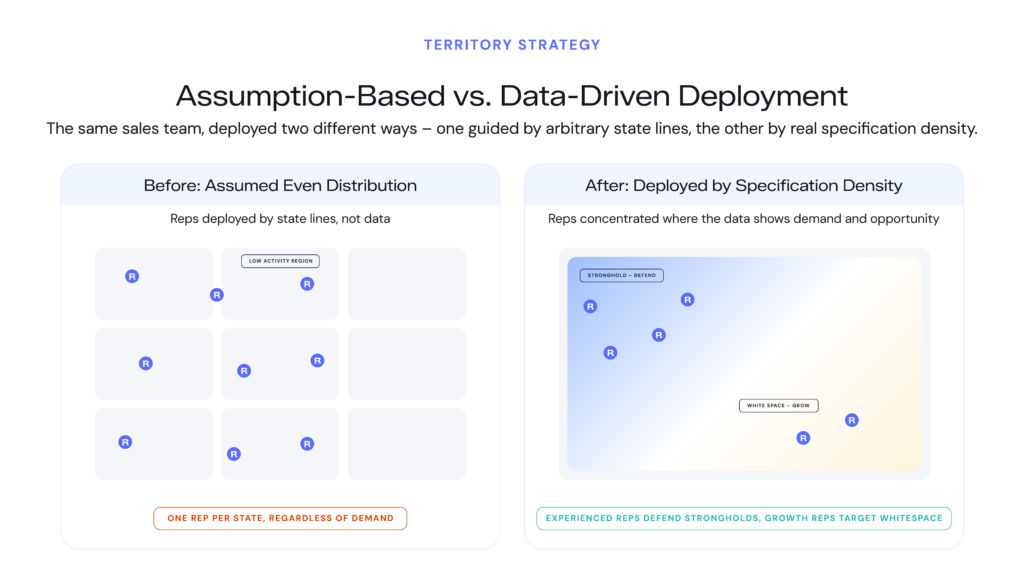
Imagine sending your best sales representatives to blanket a region where your products rarely get specified. At the same time, a different state might show organic growth in specifications for your brand, but you have no dedicated sales reps there to nurture the leads. This mismatch costs you revenue.
When you cannot see the map, you miss critical market shifts. Construction activity fluctuates by region, city, and even county. If you do not know where your products currently hold ground, you cannot defend those territories from competitors. You also cannot confidently expand into new markets.
Why “Where” Matters Just as Much as “How Often”
Knowing your overall specification frequency is a great start. Knowing the exact location of those specifications takes your strategy to the next level. “Where” actually means two different things in the construction industry: geographic location and project type.
Mapping Your Geographic Strongholds
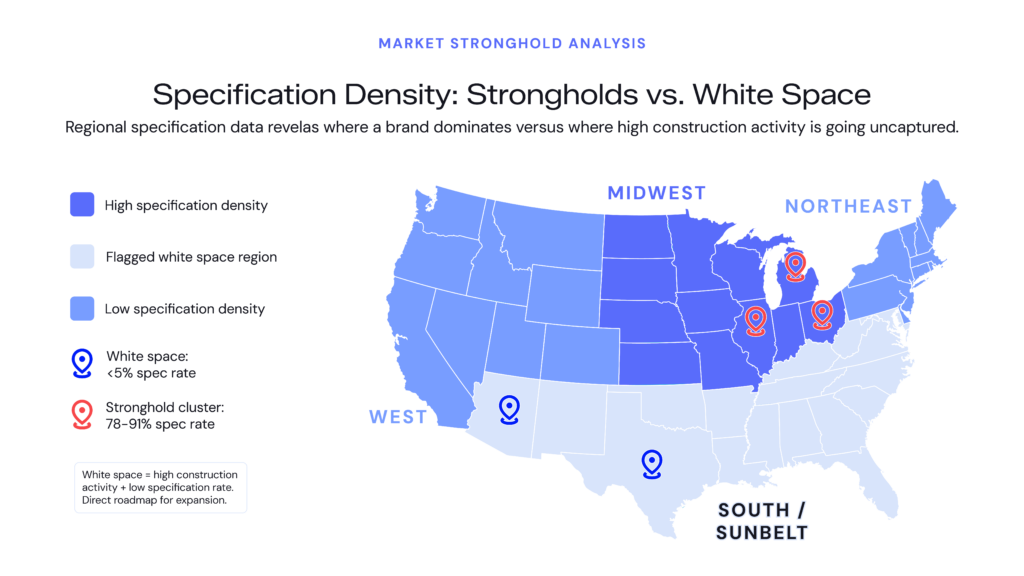
Geographic data tells you which cities, states, and regions favor your products. This information helps you identify your core market strongholds.
A stronghold represents an area where architects and engineers consistently choose your brand over the competition. Once you identify these areas, you can investigate why you succeed there. Perhaps your product perfectly meets a specific local building code. Maybe your regional sales manager built an incredible network of loyal architectural firms.
Understanding your strongholds allows you to protect them. You can allocate specific marketing dollars to maintain brand dominance in these areas. You can also reverse-engineer your success and apply those same tactics to underperforming regions.
Tracking Success by Project Type
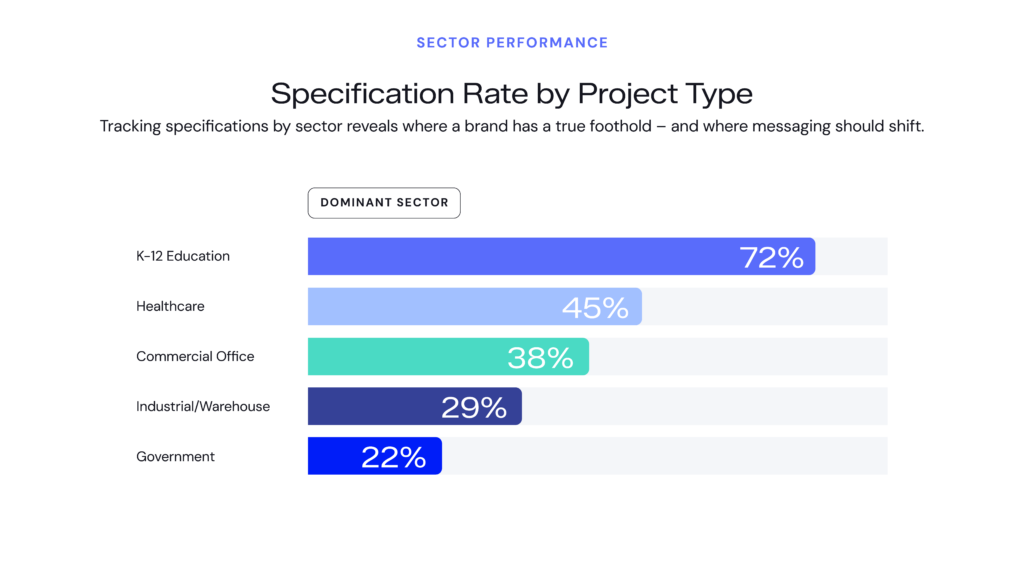
Location also refers to the type of building where your product gets specified. Does your flooring end up in commercial office buildings, K-12 schools, or large healthcare facilities?
Different project types operate on different cycles and require different approaches. If you discover that your acoustic ceiling tiles dominate the education sector, you can tailor your messaging to highlight classroom benefits. You can train your sales team to speak directly to the needs of school board planners and educational facility architects.
Tracking specifications by project type helps you balance your portfolio. If commercial office construction slows down globally, you can quickly pivot your focus to the healthcare or government sectors, provided you know you already have a foothold there.
Uncovering Underserved Regions
Data does not just show you where you win. It clearly highlights where you are missing out. We call these areas white space opportunities.
White space represents regions or project types with high construction activity but low specification rates for your brand. Finding these gaps gives you a direct roadmap for business growth.
Consider a commercial roofing manufacturer based in the Midwest. Their data shows heavy specification rates across Ohio, Michigan, and Illinois. However, the data also reveals booming warehouse construction in Texas and Arizona, yet their specification rate in the Sunbelt remains near zero.
This represents a massive white space opportunity. Armed with this knowledge, the manufacturer can launch a targeted expansion strategy. They can hire a dedicated Sunbelt sales representative, run localized digital marketing campaigns, and focus entirely on capturing a share of that growing market.
Optimizing Sales and Marketing Efforts
When you know exactly where you are being specified, you can transform how your teams operate. Data replaces guesswork with precision.
Aligning Sales Territories
Your sales team represents one of your highest costs. You need to deploy them where they will generate the highest return on investment.
Geographic specification data allows you to draw smarter sales territories. Instead of dividing regions based on arbitrary state lines, you can align territories with actual specification density. You can place your most experienced representatives in high-volume areas to defend your market share. You can assign hungry, aggressive representatives to white space regions to drive new growth.
Furthermore, this data helps you evaluate sales performance fairly. If a representative in the Northeast sees a massive spike in specifications, you can reward them. If a territory drops, you can step in with support and training before the loss becomes permanent.
Running Targeted Marketing Campaigns
Marketing works best when it speaks directly to a specific audience. Generic, nationwide campaigns often waste money.
Specification data allows your marketing team to create highly targeted campaigns. If your data shows strong adoption of your energy-efficient windows in California, you can run localized ads focusing on strict state energy codes. If you want to break into the hospital construction sector, you can sponsor healthcare design conferences and publish case studies specific to medical facilities.
Targeted marketing yields higher conversion rates. It ensures your message reaches the architects and specifiers most likely to use your products, exactly where they are working.
How Dodge Construction Network Reveals the Map
Gathering this geographic and sector-specific data on your own is nearly impossible. Project plans do not automatically organize themselves into neat regional dashboards. You need powerful technology to extract and organize this intelligence.
Dodge Construction Network offers the industry’s most robust tools for tracking specification locations. We turn millions of scattered project documents into a clear, actionable map for your business.
Pinpoint Accuracy Across the Map
Our platform tracks construction projects across the entire country. We read through the specifications, addenda, and plans to find exactly where your brand gets mentioned.
Dodge Construction Network provides intuitive, visual dashboards that map out your specifications. You can zoom in on specific states, counties, or metropolitan statistical areas. You can see your market penetration change in real-time. If an architect in Seattle specifies your product today, you see it on your map immediately.
This pinpoint accuracy eliminates the geographic blind spot. You always know exactly where your products hold power and where you need to improve.
Deep Sector-Specific Insights
We also categorize every project by type. Our tools allow you to filter your specification data across dozens of different construction sectors.
You can easily pull reports showing your performance in commercial, residential, industrial, or institutional builds. Dodge Construction Network helps you track your growth within specific verticals over time. This level of detail empowers your leadership team to make strategic decisions about product development and market expansion.
We also show you where your competitors are getting specified. If a rival brand dominates the hospitality sector in the Southeast, our tools reveal their stronghold. You can use this intelligence to disrupt their market share and position your products as the superior alternative.
Take Command of Your Market Geography
You cannot maximize your revenue if you do not know where your products are going. Understanding the geographic and sector-specific location of your specifications is vital for sustainable growth.
When you map your market, you empower your sales team, optimize your marketing spend, and uncover lucrative new opportunities. You stop reacting to the market and start actively targeting the regions and projects that drive your business forward.
Stop guessing where your products are specified. Let data draw the map. Explore how Dodge Construction Network can provide the exact location intelligence you need to dominate your market and win more business today.
Related Articles:
How Often am I getting Spec’ed? Track Your True Market Power Blog