
By Sarah Martin, Director of Economic Research
The bottom line
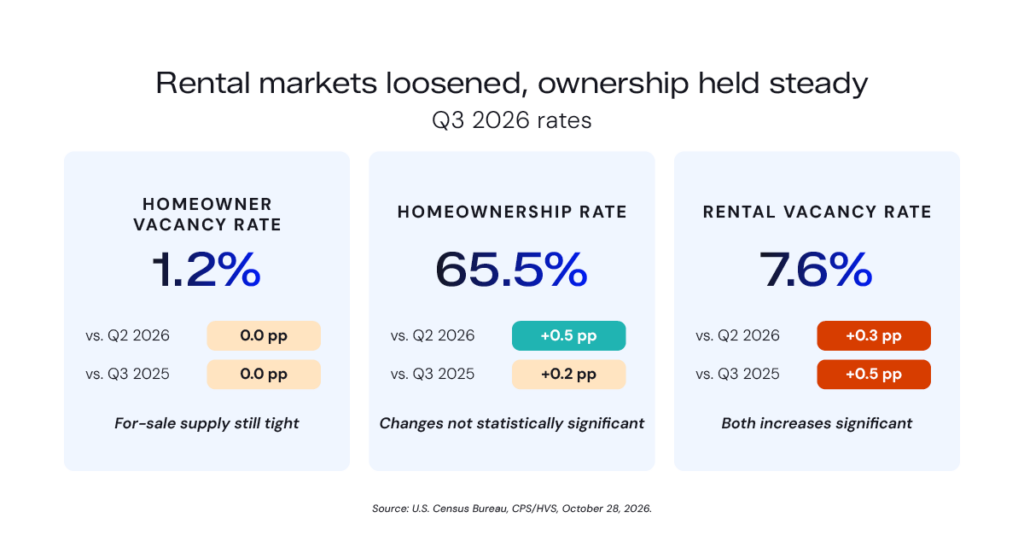
Rental housing loosened noticeably in the third quarter. According to the U.S. Census Bureau, the rental vacancy rate rose to 7.6%, a statistically significant increase from both the prior quarter and a year earlier, while the homeowner vacancy rate held at 1.2% and homeownership edged up to 65.5%. Dodge’s estimate of the national housing shortage narrowed to about 794,000 units, the smallest gap since 2018, which signals slower lease-up and softer rents for multifamily developers in oversupplied Sun Belt markets. Single-family builders still face a tight for-sale market, and the Northeast deficit remains the strongest case for new residential construction.
Key indicators
What the data shows
The rental market drove the quarter’s results. Vacant rental units rose 3.7% from the second quarter and 8.9% from a year earlier, while renter-occupied households grew by only 0.2% over the same twelve-month period. This indicates that new apartment supply is entering the market faster than renter household formation can absorb it. Rents reflect that imbalance: the median asking rent for vacant units reached $1,541, up just 0.7% from the prior quarter, but down in real terms after adjusting for inflation.

The loosening came from expensive coastal markets rather than the Sun Belt. The Northeast and West together added about 219,000 vacant rental units over the year, roughly two-thirds of the national increase. As a result, both regions’ vacancy rates rose to 6.2% and 6.7% respectively. The South still has the highest regional vacancy rate at 9.2%, but its count of vacant rentals fell 3.6% from the second quarter.
The ownership market, meanwhile, looks tighter. The homeowner vacancy rate remained unchanged over the quarter and owner-occupied households grew by 0.9%. Due to weaker demand, the median asking price for vacant for-sale homes fell 3.3% from a year earlier to $353,600. Young households remain the weak link, with under-35 homeownership rates at 36.6%, down from 37.5% a year ago.

Trend context
Throughout the pandemic years, multifamily and single family construction boomed, alongside strong demographic trends, namely rapid rates of international immigration and above-average rates of domestic migration. Consequently, the count of vacant rental units now stands at its highest level since late 2011, 55% above its mid-2020 low. Alongside an onslaught of new rental supply, the rental vacancy rate also reached a bottom of 5.6% in 2022 and has climbed in fits and starts since. The single family side of the market, however, remains much tighter. Homeownership rates have moved sideways between 65.0% and 66.0% since 2022. Additionally, the homeowner vacancy rate rose from 0.7% in 2023 to 1.2%, still quite low by historical standards.
What it means for construction
Dodge’s housing shortage estimate traces the same arc from the other direction. Each quarter, Dodge leverages this Census report to estimate the national housing shortage – estimating state-by-state how many units would be required to return a state back to its long-run vacancy rate average. According to Dodge estimates, the national gap peaked at roughly 2.1 million housing units in the second quarter of 2022 and has since narrowed to roughly 794,000 units (single and multifamily units combined).

However, regional trends show a lot more variation. The Northeast accounts for about 852,000 units of the deficit, more than the entire national net. New York alone is short roughly 340,000 units, followed by Massachusetts, New Jersey, and Pennsylvania, and the region’s combined gap improved by only about 3,000 units this quarter. The jump in Northeast rental vacancies does not contradict that picture: 569,000 vacant rentals are minor against the sizable deficit, and the increase may reflect new product priced above what local renters can absorb.

The South sits on the opposite side of the ledger, and Texas shows it best. The state now carries an estimated surplus of 57,000 units, compared with a shortage of 84,000 in mid-2022, a swing of about 141,000 units in four years on the back of the apartment boom. That surplus shrank this quarter, as the South’s vacant rental count fell by 65,000, evidence that the market is working through the excess supply, but developers should expect a longer runway before new starts pencil out.
The biggest movement came from the West, where vacant rentals jumped by 183,000 in a single quarter. California’s shortage fell from 154,000 units in the second quarter to 57,000, its smallest gap since at least 2015, and seven states, including Arizona, Utah, Nevada, and New Mexico, crossed from shortage into surplus. Local balance sheets now matter more than national averages. Residential investment should follow the persistent deficits of the Northeast and the industrial Midwest, rather than chase markets that have already built their way out in the near-term.
