
Chasing every construction project is a reliable way to burn out your sales team and drain your marketing budget. The construction industry is massive – but growth doesn’t move through it evenly. While one sector stalls, another is breaking ground at record pace. The manufacturers who win consistently are the ones who know exactly where the money is moving before their competitors do.
Precise market segmentation is how you get there. By dividing the broader construction landscape into specific, high-value pockets, you can focus your resources, sharpen your messaging, and get your products specified while rivals are still figuring out where to look.
This post will show you how to use Dodge Construction Network to identify those high-growth segments – and how to act on what you find.
Why Broad Market Thinking Leaves Money on the Table
Segmentation isn’t a nice-to-have. It’s the difference between a targeted strike and throwing darts in the dark.
Without it, you spread resources too thin. You end up marketing industrial roofing to regions booming with residential development. Your sales team burns hours calling on firms with no upcoming projects that match your capabilities. You’re everywhere and effective nowhere.
Proper segmentation fixes this. It surfaces specific pockets of rapid growth and reveals exactly which architects, general contractors, and project owners are driving that expansion. The result: the right product in front of the right person at exactly the right time.
How Dodge Construction Network Powers Smarter Segmentation
Effective segmentation requires data that is deep, accurate, and current. Dodge Construction Network gives building product manufacturers the tools to cut through the noise and see precisely where the market is expanding.
Drill Into Specific Project Types – Not Just Broad Categories
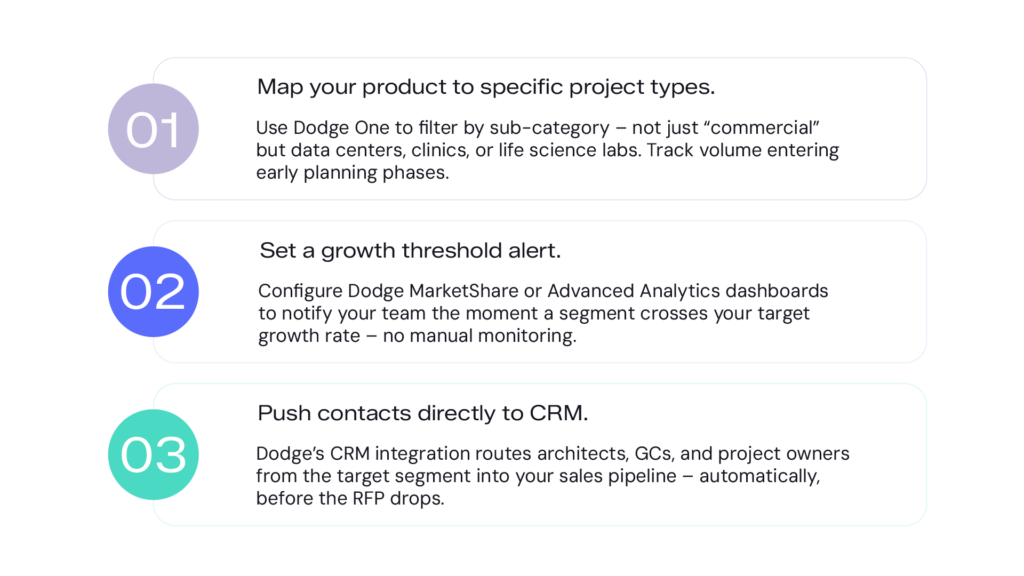
Dodge One tracks hundreds of thousands of construction projects across North America with a level of granularity that broad market reports simply can’t match. You’re not stuck with vague labels like “commercial construction.” You can drill into data centers, outpatient clinics, mixed-use retail, or any number of specific sub-categories.
By tracking the volume of projects entering early planning phases within each micro-segment, you can identify which niches are preparing for growth – before the wave crests.
Turn Data Into Decisions With MarketShare and Advanced Analytics
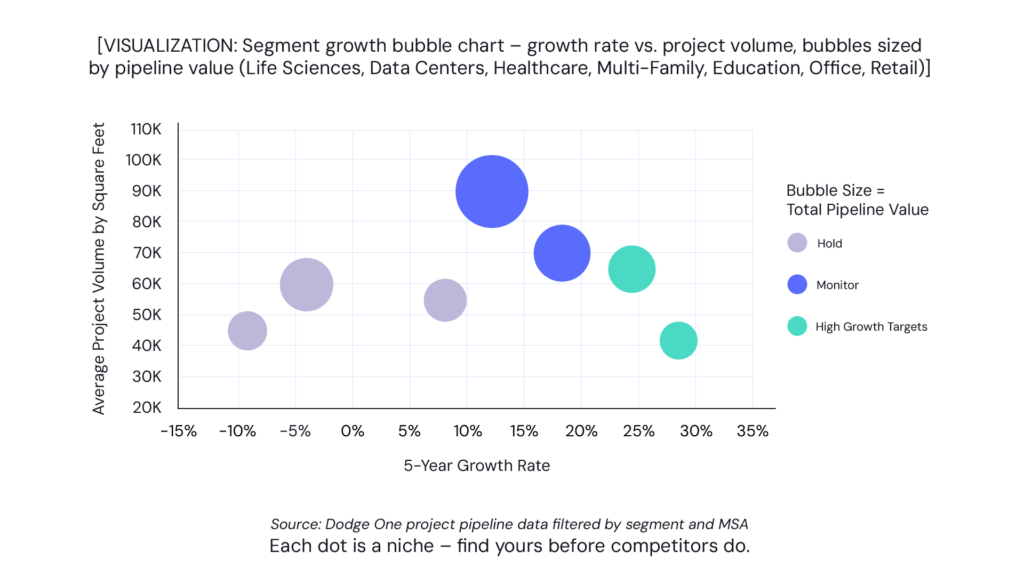
Raw data is a starting point. Visualized data is a competitive weapon. Dodge MarketShare and Advanced Analytics let you build custom dashboards calibrated to your specific product lines. If you manufacture high-end acoustic ceiling tiles, configure your dashboard to monitor educational and corporate office segments. The analytics engine tracks historical performance, current momentum, and predictive forecasts across more than 20 building types.
Set a growth threshold, and your sales team gets an alert the moment a segment crosses it – no manual monitoring required.
Read the Market Before It Moves With Sweets
Architects and design professionals use Sweets to research and select building products. The behavioral data generated on that platform is a powerful signal of where design intent – and future demand – is heading.
If searches for sustainable insulation materials spike in the Pacific Northwest, you’ve identified a high-growth product segment in a specific geography. That’s demand you can act on before projects even reach the bidding phase, giving you a material head start on every competitor waiting for the RFP.
Three Ways Manufacturers Are Using This Data Right Now
Scenario 1: Pivoting Out of a Slowing Market
Your company has built its business on single-family residential construction. Rising interest rates have cooled new starts significantly, and you need to pivot before revenue takes a hit – but you’re not sure where to go.
You run a segment analysis in Dodge One, looking 24 months out. The data shows a major surge in high-density, multi-family apartment complexes entering schematic design in urban centers. You now have a target. You filter for the top architectural firms driving these projects and launch a focused campaign demonstrating how your products scale for high-density residential builds. By the time your competitors realize single-family isn’t bouncing back, you’ve already established yourself in the new segment.
Scenario 2: Owning a Niche No One Else Is Watching
You manufacture specialized HVAC systems built for environments requiring strict climate control – laboratories, pharmaceutical facilities, advanced manufacturing. Broad commercial construction trends are meaningless to you. You need to find the specific niches where your product is not just competitive, but essential.
Using Dodge One and MarketShare, you filter the commercial market to isolate life science, pharmaceutical, and advanced manufacturing construction. The data surfaces something striking: life science construction projects in the Northeast are growing at 15 percent year-over-year. That segment becomes your priority. You extract contacts for the mechanical engineers and general contractors tied to these projects and redirect your sales team entirely. You’re pitching to exactly the people who need what you build – in a market that’s growing fast and not yet crowded.
Scenario 3: Finding the Regional Boom Hidden in National Averages
National data can be misleading. When you see flat retail construction numbers across the country, it’s tempting to write off the category. But national averages routinely bury regional surges.
You map retail construction projects entering the pipeline nationwide using Dodge One, filtering by project value to exclude minor renovations. What appears on that map: a dense cluster of high-value retail developments planned across three counties in central Texas. The national picture looks stagnant. The regional picture looks like an opportunity. You temporarily shift sales coverage to those counties, increase localized digital advertising by zip code, and capture the regional boom while competitors are focused on the aggregate numbers.
From Insight to Pipeline
Identifying a high-growth segment is step one. Activating it is what drives revenue.
Connect your Dodge data directly to your CRM via Dodge’s native CRM integration. When a segment hits your growth threshold in MarketShare and Advanced Analytics, push the associated companies and contacts into your sales pipeline immediately. Set project alerts in Dodge One so your team knows the moment a new opportunity enters your target category. The goal is a system where intelligence flows automatically into action – no manual handoff required.
Your Next Move
Growth in the construction industry is constant. It just isn’t evenly distributed. The manufacturers who find it first – and focus there – are the ones who win the most profitable projects.
Here’s where to start:
- Map your product lines to their ideal project types – be specific about what a great-fit project looks like.
- Analyze the early-stage pipeline in Dodge One – see which of those project types are accelerating.
- Look for the outliers – geographic clusters in MarketShare and emerging product demand in Sweets are where the best opportunities hide.
Stop spreading resources across the entire market. Use data to find where the growth exists – and put everything you have behind it.
Related Articles:
Where Am I Winning Vs Losing? A Guide to Market Share